
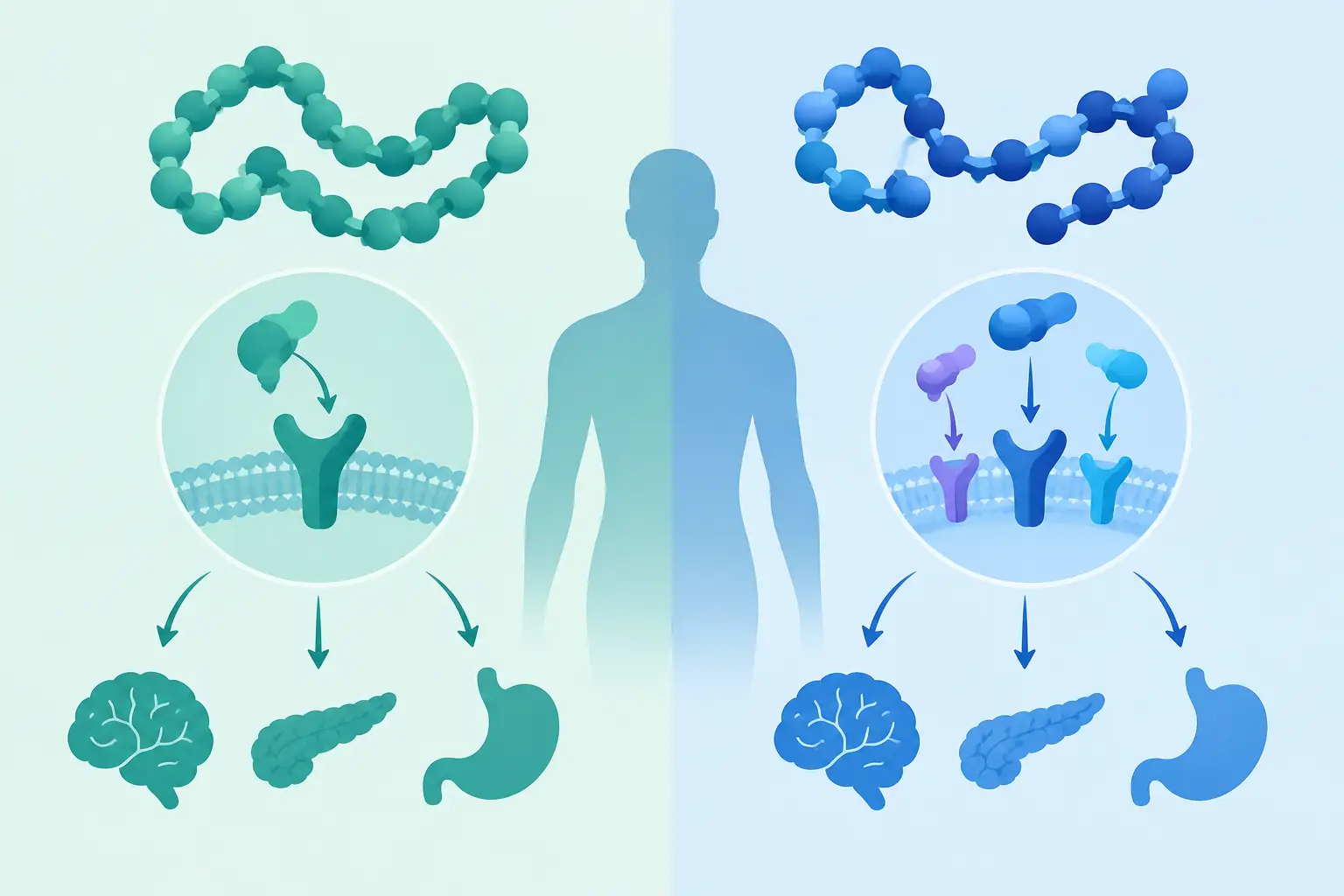
Retatrutide versus tirzepatide mechanisms differ by one receptor with meaningful metabolic consequences. Tirzepatide is a dual incretin receptor agonist targeting GLP-1 and GIP receptors. Retatrutide adds glucagon receptor agonism, creating a three-receptor research profile that may affect appetite signaling, insulin dynamics, energy expenditure, and substrate use differently.
For researchers comparing metabolic peptides, the practical distinction is not simply that retatrutide is "stronger." Each receptor contributes a separate signaling input, and the net response depends on receptor expression, tissue context, dose exposure, study duration, diet, and the endpoints being measured. These compounds should not be treated as direct one-to-one substitutes.
Retatrutide Versus Tirzepatide Mechanisms at a Glance
Tirzepatide activates glucagon-like peptide-1 (GLP-1) and glucose-dependent insulinotropic polypeptide (GIP) receptors. Both are incretin pathways, meaning they participate in nutrient-responsive endocrine signaling. Its design centers on combining GLP-1-mediated appetite and glycemic effects with GIP receptor activity.
Retatrutide activates the same GLP-1 and GIP receptors while also engaging the glucagon receptor. That third target is the key mechanistic variable. Glucagon signaling is associated with hepatic glucose output under some conditions, but it also has roles in lipid metabolism and energy expenditure. Adding it to incretin agonism produces a more complex metabolic model than dual agonism alone.
At the intracellular level, these receptors are primarily G protein-coupled receptors that can increase cyclic adenosine monophosphate (cAMP) signaling after activation. cAMP is a second messenger involved in multiple downstream processes, including insulin secretion in pancreatic beta cells and metabolic signaling in liver and adipose-related pathways. Receptor activation in a cell assay does not, by itself, predict the full effect in an organism.
Tirzepatide: Dual GLP-1 and GIP Receptor Activity
GLP-1 receptor signaling
GLP-1 receptor agonism is associated with glucose-dependent insulin secretion, reduced glucagon secretion in hyperglycemic states, delayed gastric emptying, and central appetite regulation. "Glucose-dependent" is an essential qualifier. The insulinotropic action is generally more pronounced when circulating glucose is elevated, rather than functioning as continuous insulin replacement.
GLP-1 signaling also reaches appetite-regulation circuits in the brain. In research settings, this is commonly evaluated through food intake, body-weight change, gastric emptying, and measures of satiety-related behavior. The relative contribution of central versus gastrointestinal pathways can vary across models and study designs.
GIP receptor signaling
GIP is another endogenous incretin hormone. Its receptor is expressed in pancreatic beta cells and in several additional tissues, including adipose tissue and the central nervous system. When combined with GLP-1 receptor activation, GIP agonism may modify insulin secretion, nutrient handling, and tolerability-related effects observed with GLP-1-focused approaches.
The biology of GIP is more nuanced than a simple appetite-suppression label. Its effects may differ with nutritional state, insulin sensitivity, adiposity, and concurrent GLP-1 receptor activity. That is why a dual agonist cannot be understood by adding two separate single-receptor descriptions together.
What dual agonism means in practice
Tirzepatide's dual-target mechanism is comparatively focused: two incretin receptors, both tied to post-meal metabolic signaling. In a controlled research framework, this makes it suitable for examining questions around glucose-stimulated insulin response, caloric intake, body composition, gastric motility, and incretin-pathway interaction.
Tirzepatide is also the more clinically established molecule. Prescription tirzepatide products have FDA-approved indications, but that status applies to approved drug products used under medical supervision, not to general research materials. A laboratory-grade peptide, its presentation, and its intended use must be evaluated separately from branded pharmaceutical products.
Retatrutide: Adding the Glucagon Receptor
The glucagon receptor changes the model
Retatrutide's glucagon receptor activity is what separates its mechanism from tirzepatide. Glucagon is often introduced as the hormone that raises blood glucose by signaling the liver to release glucose. That description is accurate but incomplete. Glucagon receptor activation can also influence hepatic lipid metabolism, fatty-acid oxidation, and energy expenditure.
In isolation, glucagon receptor agonism could create concerns around increased hepatic glucose production. Retatrutide's research premise is that concurrent GLP-1 and GIP receptor agonism may counterbalance portions of that glycemic effect while retaining metabolic actions associated with glucagon signaling. Whether this balance is favorable depends on exposure, physiology, and the measure being studied.
This is the central trade-off in triple agonism. A third receptor expands the potential range of metabolic effects, but it also adds another physiological system that must be monitored. Changes in body weight, for example, do not identify whether the primary driver was food intake, energy expenditure, fluid shifts, lean-mass change, or a combination of factors.
More targets do not mean a simple linear increase
It is tempting to frame retatrutide as tirzepatide plus an added benefit. Mechanistically, that is too simplistic. Receptors can produce different effects across tissues, and the same receptor may have different consequences depending on baseline metabolic state. Pharmacokinetic profile also matters: peak concentration, total exposure, half-life, and receptor occupancy all influence the observed response.
Assay conditions matter as well. Potency can be reported differently depending on whether a study measures cAMP generation, receptor binding, beta-arrestin recruitment, insulin release, or an animal-level endpoint. Comparing a single potency figure across separate studies can obscure more than it clarifies.
Key Research Differences to Control
A useful retatrutide versus tirzepatide comparison starts with matched conditions. If the goal is to identify receptor-level differences, researchers should avoid comparing unrelated formulations, inconsistent purity documentation, or substantially different exposure schedules.
Four variables deserve particular attention:
- Target engagement: Tirzepatide engages GLP-1 and GIP receptors; retatrutide engages GLP-1, GIP, and glucagon receptors.
- Primary metabolic hypothesis: Dual agonism emphasizes incretin coordination, while triple agonism tests incretin coordination plus glucagon-associated energy and lipid signaling.
- Outcome selection: Food intake, glucose tolerance, insulin, glucagon, resting energy expenditure, lipid markers, and body composition answer different questions.
- Interpretation limits: Weight change alone is not a complete metabolic endpoint, particularly when glucagon receptor signaling is involved.
For in vitro work, receptor-specific assays can help separate direct signaling from whole-organism effects. For in vivo research, glucose monitoring and appropriately selected metabolic endpoints are particularly relevant when evaluating a glucagon-active compound. Human findings should not be extrapolated from cell or animal data without recognizing those limitations.
Safety, Regulatory Status, and Material Verification
Retatrutide remains investigational and is not FDA approved. Tirzepatide has approved prescription-drug uses in specific branded forms, but approval does not make all material described as tirzepatide equivalent to a regulated drug product. Researchers and buyers should distinguish between pharmaceutical supply chains and research-compound supply chains.
Mechanism does not establish suitability, safety, sterility, identity, or potency. GI effects, altered glucose handling, and other physiological responses may be relevant considerations for incretin-active compounds, while glucagon receptor activity adds further metabolic complexity. Medical decisions should be made with a qualified clinician, not from receptor descriptions or product marketing.
For research materials, batch identity and analytical documentation are practical controls. Independent certificates of analysis can support verification of a stated batch and test result, but they do not replace study design, handling controls, or regulatory review. NYOVY organizes batch-level documentation to help buyers evaluate material traceability before selecting a research compound.
The most useful question is not which peptide is categorically better. It is whether a dual-incretin model or a triple-agonist model matches the receptor biology and endpoints of the research question at hand.