
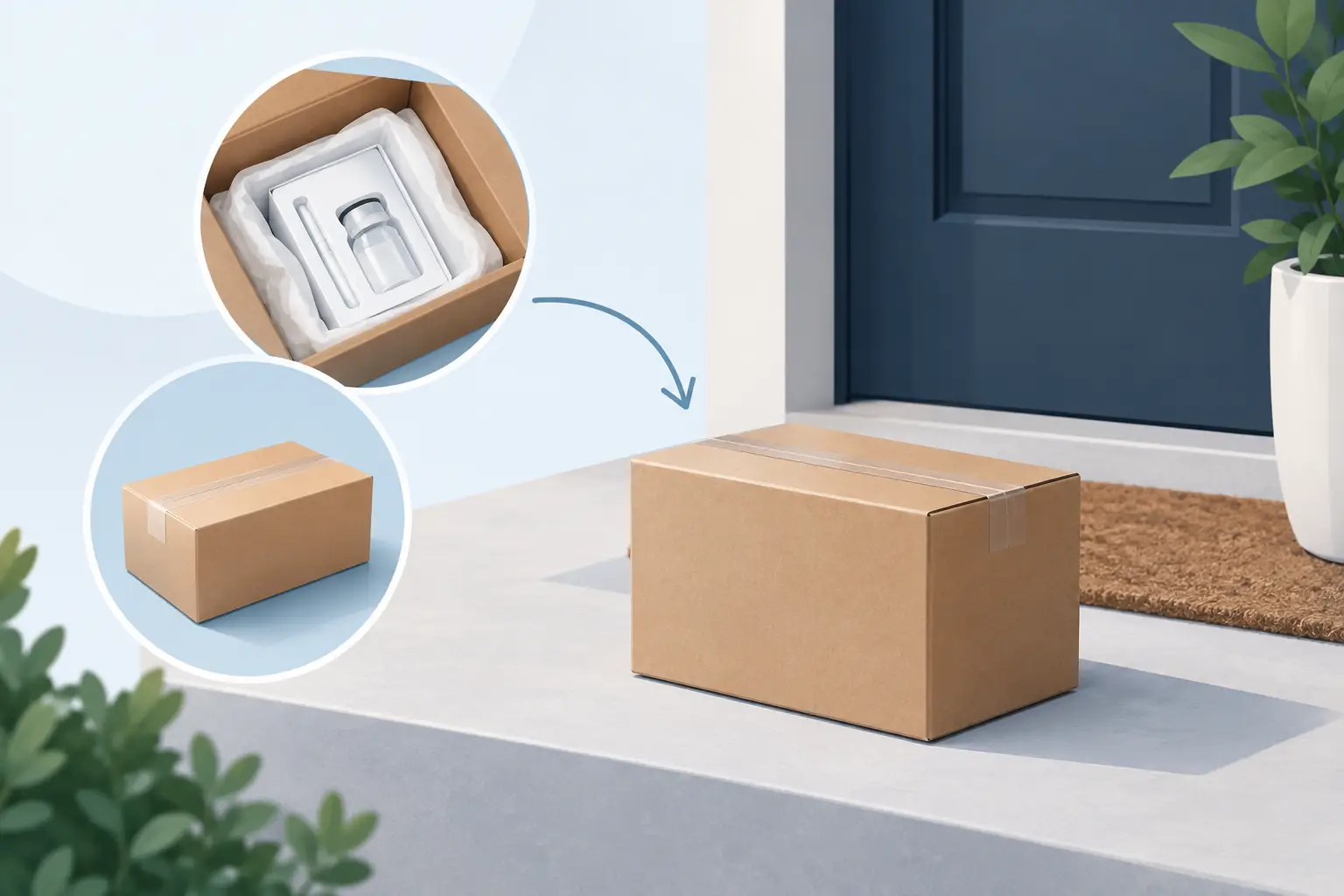
A discreet peptide package delivery should not force a choice between privacy and order visibility. The outside of the shipment can remain neutral while the buyer still receives practical confirmation of preparation, carrier handoff, tracking activity, and batch documentation. For laboratory-grade research compounds, that balance matters: a plain box is useful, but it is not a substitute for a verifiable product record.
For US buyers, discretion is usually about limiting unnecessary information on the exterior label and managing the delivery process predictably. It is not about bypassing carrier requirements, obscuring a transaction from the purchaser, or removing the information needed to verify what was ordered. A well-run fulfillment process keeps those boundaries clear.
What discreet delivery should mean
Discreet exterior packaging generally means the parcel arrives in a plain mailer or unbranded box, with no oversized product imagery, compound names, or promotional language displayed on the outside. The shipping label still needs the recipient name, delivery address, return address, and carrier-required service details. That is standard logistics, not a privacy failure.
The goal is straightforward: someone handling the parcel should see an ordinary shipment, not a description of its contents. The order record, itemized confirmation, and any applicable batch certificate belong in the buyer's account, email confirmation, or product documentation rather than on the exterior packaging.
Discretion also applies to the buying experience before a label is created. A clear checkout should show the final price in USD, available payment methods, shipping options, and the information needed to receive tracking updates. Buyers should not have to guess whether an order has been accepted, whether payment has cleared, or when preparation begins.
Privacy does not replace traceability
A plain package alone says very little about the product inside. In the peptide market, privacy and verification solve different problems. Privacy limits unnecessary exposure during transit. Traceability helps a buyer connect a received vial or pen to the correct item, lot or batch identifier, and independent certificate of analysis.
This distinction is especially relevant when comparing research products with similar names, concentrations, or formats. A label that identifies an internal SKU or batch can support verification without turning the shipping carton into an advertisement. The useful details should be available to the purchaser after ordering, not visible to every person who encounters the parcel.
Independent COA testing is one of the practical signals to look for. A certificate should identify the tested material and provide batch-relevant information that can be compared with the product record. Named third-party laboratory documentation, including independent laboratory testing where applicable, gives buyers a concrete basis for review rather than a generic purity claim.
At NYOVY, discreet exterior packaging is paired with transparent batch documentation and tracked shipping. That pairing is the relevant standard: quiet at the doorstep, specific in the records.
The delivery timeline: preparation, dispatch, transit
Buyers often treat these stages as one event, but they are separate. Order preparation is the period when the seller confirms the order, allocates inventory, completes packing, and generates a shipping label. Dispatch occurs when the carrier receives the parcel. Transit begins when carrier scans show movement through its network.
A stated preparation window of 24-48 hours gives a reasonable operational expectation, but it is not the same as guaranteed arrival time. Weekends, federal holidays, address corrections, weather events, and carrier volume can affect the timeline after dispatch. The most useful seller communication distinguishes its own handling window from carrier transit estimates.
Tracking is valuable because it closes that handoff gap. A label-created notice can confirm preparation, while an acceptance or origin scan indicates the carrier has taken possession. Subsequent scans provide the best available view of movement and expected delivery. If tracking remains unchanged shortly after label creation, allow the stated preparation period and the carrier's initial scan window before assuming a problem.
What to check before placing an order
A discreet order starts with accurate information. Confirm the recipient name, street address, apartment or unit number, ZIP code, and a phone number or email capable of receiving delivery notifications. Small address errors can create more exposure and delay than any packaging choice.
Before checkout, verify the product format and strength. A lyophilized vial, a multi-vial bundle, and a peptide pen are different fulfillment items even when they relate to the same research category. Confirm the exact compound name, listed amount, and quantity in the cart. This is particularly useful for buyers comparing metabolic research compounds such as tirzepatide or retatrutide with recovery-focused products such as BPC-157 or TB-500.
Review the documentation available for the selected product or batch. The key question is not whether a site uses scientific language. It is whether the relevant product can be connected to documentation that identifies the material tested. Batch-level records are more useful than a broad statement that all inventory is tested.
Finally, use a delivery location where you can receive the parcel promptly. A secure home address may be suitable for some buyers; others may prefer a location with controlled access and reliable receipt of packages. The right choice depends on local delivery conditions, building access, and how long a parcel might remain unattended.
How to handle the package after delivery
When the shipment arrives, inspect the exterior before opening. Confirm the recipient information and look for visible signs of crushing, moisture exposure, tears, or tampering. A neutral outer box is expected with discreet shipping, so evaluate condition rather than looking for product branding on the carton.
Open the package in a clean, dry area and compare the contents with the order confirmation. Check the item name, format, quantity, and any identifying batch or SKU fields. If your product documentation includes a corresponding batch reference, compare it before disposing of packing materials.
If there is a discrepancy, retain the shipping carton, packing slip if included, and clear photos of the condition and contents. Contact support using the order number and a concise description of the issue. This creates a useful record and makes it easier for the fulfillment team to review what occurred.
Do not assume that a discreet shipment requires vague records. A legitimate purchase should still provide the buyer with an order confirmation, shipment notice, tracking details, and access to relevant product documentation. The exterior should be private; the transaction should be accountable.
Common mistakes that reduce privacy
The most frequent issue is entering an incomplete address, then requesting a carrier change after dispatch. Reroutes, holds, and delivery exceptions can add days and may create additional notifications. Confirming the address at checkout is usually the simplest privacy measure.
Another mistake is sharing tracking links or order screenshots widely. Tracking data can reveal delivery timing and location, even when the package itself is plain. Keep order emails, account credentials, and shipment notifications private in the same way you would protect other purchase records.
Buyers should also avoid treating carrier estimates as fixed appointments. If a signature service, delivery alert, or alternate location is available through the carrier, it may help, but availability varies by service level and destination. Plan around the tracking window rather than waiting until a package has already been marked delivered.
A practical standard for discreet peptide package delivery
The best discreet peptide package delivery process is quiet on the outside and precise everywhere else. It uses neutral packaging, accurate labels, secure checkout, a defined preparation window, carrier tracking, and documentation that lets the buyer verify the order without public-facing product disclosure.
Privacy is strongest when it is supported by operational discipline. Choose a seller that can explain how orders are prepared, when they dispatch, how tracking is provided, and how batch documentation is maintained. Then make the delivery plan part of the order itself: use accurate information, monitor the carrier updates, and verify the received product against the records you were given.